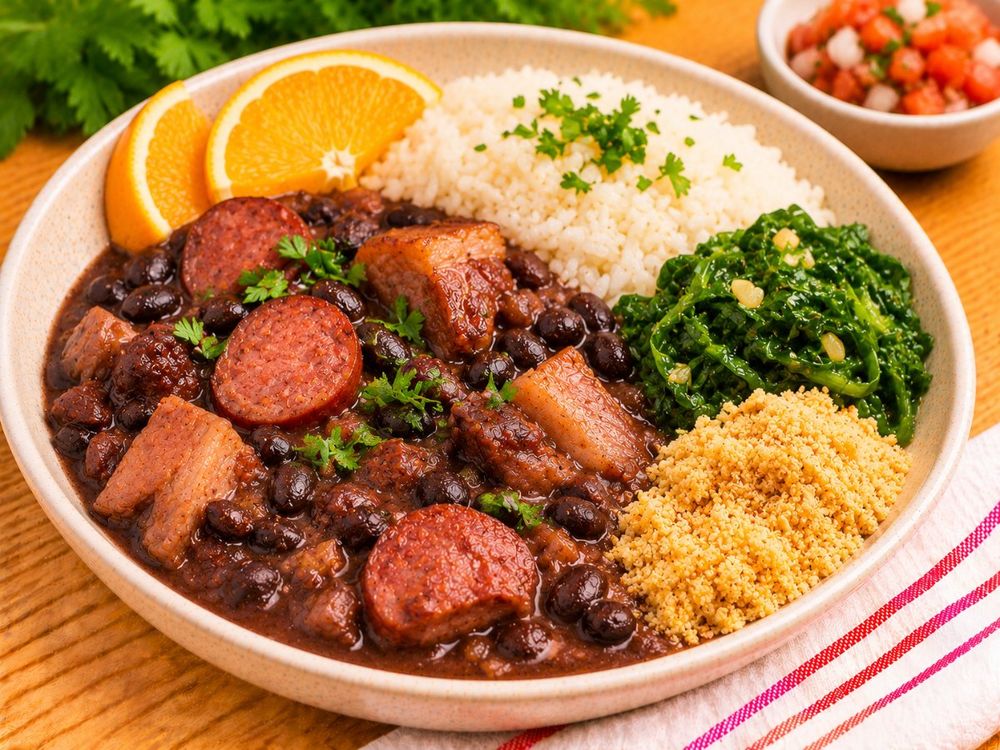
Feijoada (Brazilian black bean stew)
Black beans slowly stewed with pork shoulder, smoked sausage and a little bacon, with onion, garlic and bay. A lighter home version than the restaurant one, served the Brazilian way with rice, sautéed kale and orange slices.
Jump to ingredients ↓Allergens
No major allergens in the ingredients.
We cannot guarantee the absence of traces (cross-contamination). Allergens don't include what you add when serving (e.g. sour cream, bread).
Ingredients
6 servings
Tap the circle to tick what you've prepared.
- 3 cansCooked black beans — drained
- 500 gPork shoulder — 3 cm cubes
- 200 gSmoked sausages
- 80 gBacon
- 2OnionAlternative: Red onion
- 5 clovesGarlic
- 3Bay leaves
- 600 mlWater
- 1 tbspSunflower oilAlternative: Olive oil
- 300 gRiceAlternative: Basmati rice
- 300 gKale
- 2Oranges
- to tasteSalt
- to tasteBlack pepper
Method
Cut the bacon into strips and fry it in a heavy pot without oil for 4–5 minutes, until the fat runs.
⏱ 5 min
Add the pork and brown it all over for 6–8 minutes. Add the chopped onion and 3 garlic cloves and cook for 5 more minutes.
⏱ 13 min
Pour in the water, add the bay leaves and simmer covered over low heat for 1 hour, until the pork is tender.
⏱ 60 min
Add the beans and sliced sausage. Simmer uncovered for another 30 minutes. Mash a ladleful of beans against the side of the pot to thicken the stew. Season with salt and pepper.
⏱ 30 min
Meanwhile, cook the rice according to the packet instructions.
⏱ 18 min
Strip the kale from its stems, shred it finely and sauté it in the oil with the remaining garlic for 3–4 minutes, until wilted but still green.
⏱ 4 min
Serve the feijoada with the rice, kale and orange slices.
Serving: Serve with plain rice, garlicky sautéed kale and orange slices to cut through the richness.
Storage: Keeps 4 days in the fridge and is better the next day; the stew freezes for 3 months.
Nutrition (per serving)
Fibre: 13.2 g · Sugars: 5.9 g · Salt: 2.5 g · per 100 g: ~131 kcal
Nutrition values estimated from verified data.
Sources: CIQUAL 2025 table (ANSES, version of 3 Nov 2025); USDA FoodData Central (SR Legacy, 2018).